Cambodia Reemerges

Standard

Our visit to Indochina began three weeks ago when our plane touched down one early Sunday morning in late January in Siem Reap, Cambodia. Having spent the night in the Singapore airport and having caught an early 6 AM connecting flight, we groggily stumbled outside of the clean and quaint Siem reap airport to be warmly greeted by Den, our tuk tuk driver from our hotel.   Den a small, polite man who was also cheerful in demeanor greeted us with the sompiah, the traditional Cambodian greeting where one presses his or her hands together in front of the chest and bows the head. Moments later we were whisked away on his tuk tuk and taking in the fresh, dry and cool morning air around us as we witnessed communities slowly getting going for the day. After the bustle and craziness of Manila traffic that we had left behind the night before, the quiet calm of Sunday morning in Siem Reap was a welcome change. Having left behind the Philippines and then China two weeks before that, we realized that we were now stepping into yet another kind of Asia. As we whizzed by small farming villages and approached Siem Reap in the tuk tuk, Derek leaned over and said, “I love Cambodia already.”

 

Angkor Wat at sunrise

It seems that Cambodia has experienced a boom in tourism in recent years. It may not yet attract the numbers as its northwestern neighbor Thailand, but it definitely gets its share of visitors from all over the globe. This was apparent to us immediately as we arrived in Siem Reap and saw that we were in good company with fellow tourists from the US, France, Germany, China, Russia, Australia and so on. It’s true you can hardly go more than ten feet down the main street before you are bombarded by locals offering massage services, tuk tuk transport for the day or hoping you will stop in their shop to buy a Northface knock-off backpack for $15. US dollars are the main form of currency in Cambodia and although you sometimes may get change in Riel, the local currency, all ATMS dispense dollars and most transactions down to even the grassroot level are done in dollars. Although there are no McDonalds or Starbucks in Siem Reap, gourmet sandwich and salads and Mexican food are all within a two minute walk. Siem Reap is indeed a town for tourists. Of course the main reason why we all come to Siem Reap and Cambodia for that matter is the nearby magnificent ruins of Angkor Wat. For me it was magical seeing the sun poke up behind the Angkor Wat temple at 6 am and then spending the day climbing up ruins to the treeline and imagining we were kings admiring our kingdom below. I was fulfilling a dream coming to Angkor Wat and I didn’t mind sharing it with others.
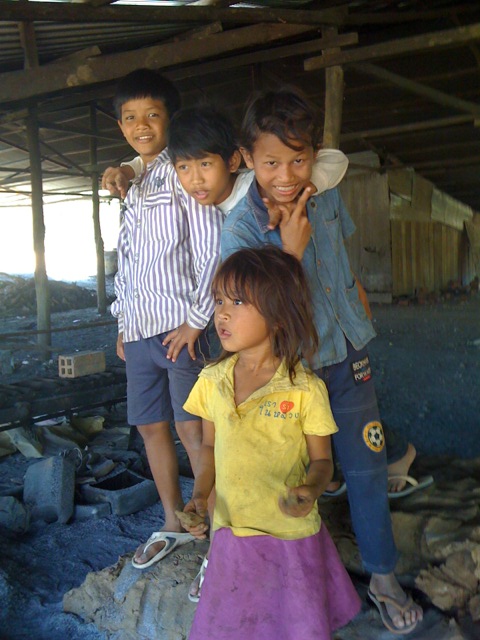
Cambodia’s future

Cambodians are gentle, quiet and polite people, particularly adults. Children we encountered seemed to come out of their shells a little more and loved greeting tourists and showing us around. I was a little surprised initially to see so many children out and about in the middle of the day and not in school. Keiko, a Peace Corps volunteer from Seattle we met, explained that many children, particularly in rural communities, go to school for half-days. This allows them to help their parents at home or in the fields for part of the day. Some children may go to school in the morning, some in the afternoon. Indeed, children really are the backbone of Cambodia and while it’s true that every country sees hope and future prospects in their children, this case is even more acute in Cambodia where 50% of its population is under the age of 22. This is a sad and sobering result of the civil war and the terror of the Khmer Rouge that ravaged Cambodia in the late 1970’s to the early 1990’s. Rarely did we see people over the age of 40 during our week in Cambodia.

From Keiko; our encounters with locals; and a booklet called “Dos and Don’ts in Cambodia” (yes- there was such a thing- and quite informative too!), we learned about some proper etiquette in Cambodia. Although it’s a country with a very young population, certain elements of society are still quite conservative. This comes from the fact that a majority of the population practices Theravada Buddhism, which I have learned is the oldest surviving Buddhist school. I got an understanding of this rich history while visiting a local wat or temple in Siem Reap. A beautiful and colorful mural told the story of Buddha in several panels around the perimeter of the temple. Unknowingly I committed one of the “Don’ts” of Cambodia by approaching one of the male monks and asking him a question about the mural’s story. You see, it is taboo for a woman to speak to a monk or for him to even look at a woman. To be fair, he did approach us, but he had another man (who was not of the cloth) in tow and he was probably trying to engage in conversation with Derek. Then, while on a bus trip from Battambang to Siem Reap, Derek had a very chatty and friendly monk sit next to him whose English was so good that he had started an English language school. Derek soon learned from his friendly monk about the gender etiquette. Derek asked what would have happened if his girlfriend had sat next to him? Without offering much reason, the monk replied, “I just couldn’t.”  This he said before calling his sister on his cel phone and having Derek chat with her in English for a few minutes! So it seems that Cambodians live with a long, proud history of tradition that is now intertwined with elements of modernity. Certain traditions and etiquette are deeply engrained and common place. Keiko explained that had I unknowingly sat next to the monk, the entire bus would have collaborated together to make sure that the monk’s honor and my humility would have been spared.

Enlightened One

Our week in Cambodia was all too short and provided us only with a sampling of its rich history; its quiet and warm people; and its stunning scenery. I envied Keiko and her boyfriend Tyler a little for having had the opportunity to spend two years experiencing Cambodia. Both Derek and I realized that one week was too short to visit it. On the day we left, it was only apt that our friend Den, out first introduction to the warmness of Cambodia, brought us to the airport. As we exchanged email addresses and said our goodbyes, I bowed to him with a sompiah and Derek shook his hand. It seemed silly that I was feeling regretful and a little choked up about leaving Cambodia after only one week. I guess we’ll have to find a way to come back again and get a greater sampling of it.
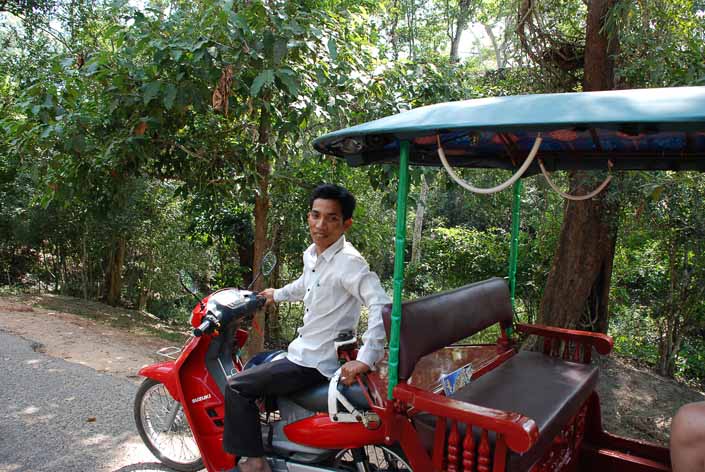
Den

Revisiting the Philippines

Standard

Dear Readers,

I finally have the chance to catch up on some blogging. Derek and I have been outside of China for the last month traveling in the Philippines, Cambodia and now Vietnam. I have had a lot of blog topic ideas in my head but somehow the time has just slipped by and next week we’ll be headed back to Nanjing where I will be thrown into a busy, hectic schedule again.

Anyway, while I have a little break in our hectic travel schedule, I thought I would first recap our trip to Philippines. The Philippines holds a special place in my heart and within my family’s history. From 1984-1989, my family lived in Manila- five influential years of my childhood and early adolescence. Before that, my parents were Peace Corps volunteers there in the early years of the program from 1965-1967. Bill, my stepfather, also lived with his family in the early 1960’s in Manila. Finally, my great-grandfather, Julius Jenss, sought adventure in Dagupan, Philippines selling slot machines in the early 1900’s in the years following the Spanish American War and the beginning of a new era of foreign influence in the Philippines.

Given my extended family history in the Philippines, it was pretty uncanny when Derek came into my life and on our first date, told me that his own father lives in the Philippines. So, it’s meant to be- the Philippines and its draw to me and my family. What has now permanently strengthened my ties with the Philippines is that Derek (and I through him) now has an extended Filipino family. On this trip down to the Philippines, we spent some time with Derek’s father Doug and also got to meet his wife Rowena and their children Angel, Faith, Derrick, Charlene and Simon. Derek’s brothers and sisters took to him very quickly and affectionately called him Kuya or “big brother” in Visayan, which they spoke along with English at home. I too have been dubbed “Auntie Steph”, which I enjoy.

For me revisiting the Philippines was also made unique by the opportunity to spend time with a Filipino family. My childhood years in Manila gave me the opportunity to meet Filipino friends as well as friends from all over the globe. However meeting Rowena’s family was the first time I really got to spend extensive time with a Filipino family and therefore learn about the important role that family plays there. What I have experienced in the US is that many children move out of home once they come of age and then only see extended family during major holidays. However, in the Philippines, it seems that many children continue to live close to their family even after they have grown up. It’s not uncommon for grown-up sisters, brothers, and even cousins to live under one roof where they may help each other out with raising each others’ children, housekeeping, cooking, etc. In a Filipino family, children therefore grow up with a large but close-knit family. This was interesting for me to see first-hand with Doug and Rowena’s family. Admittedly I am a person who needs her own time and space sometimes and would have to adjust to living under such close quarters. Nevertheless, I do relish the few times in the year when I do see my parents, sisters and grandmother as well as extended family with all my cousins and wish that spending time with them wasn’t always squished into a one week period within a year or two. Communities with strong, close-knit families like in the Philippines have their merits for sure.

In addition to meeting our Filipino family, here are some of my favorite experiences in the Philippines (not in any particular order of favorite):

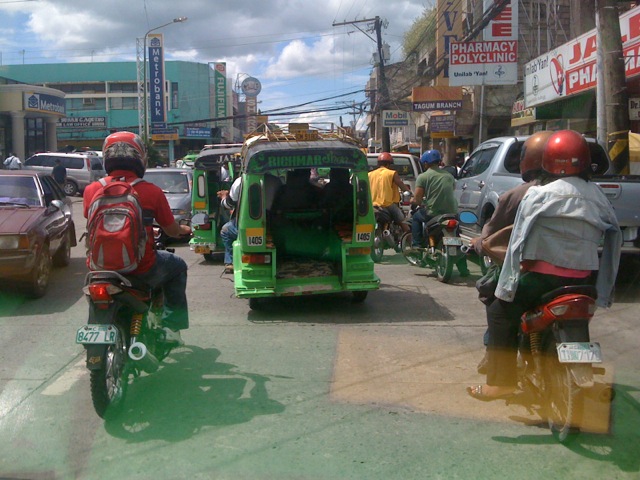
Jeepney

Riding in a jeepney and tricycle: Jeepneys are extended jeeps that the Filipinos cleverly modeled from jeeps left by American GIs in WWII. They are probably the most widely-used mode of transportation in the Philippines. Jeepneys are family owned and operated and drive along a certain route. The destinations are penned on the side of the jeepney as well as on signs on the front dashboard. Passengers enter the jeepney in the back and then sit on a long seat along the length of the jeepney facing passengers on the opposite side. A ride in Manila was only 7 Pesons, about $.20 and payment is handed up by passengers in the back to the driver in the front. Another common mode of transportation are tricycles- motorbikes with extra seats you can hop onto and tell the driver where you want to go. Sometimes you’ll have to share the ride with someone else.

Tricycles and busy streets in Tagum
Bangka boat

Bangka boats, nipa huts, disappearing islands, and snorkeling: Need I say more? Beautiful white sand beaches, untouched coral reefs with bright blue star-fish and an array of tropical fish. And to top it off, how about some freshly cracked coconut juice picked from the tree five minutes before while you were out snorkeling?

Nipa hut
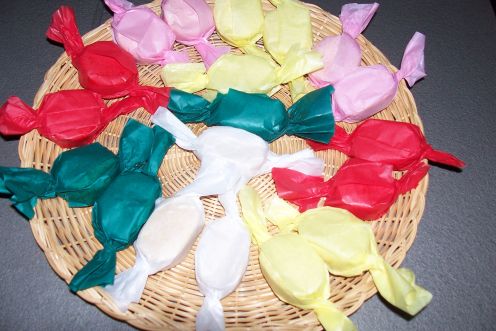
Polvoron

Polvoron, calamansi juice and Chippy: My favorite Filipino snacks and junkfood. Polvoron is powdered milk candy. Sounds strange but yummy!

Karaoke singing at home or by the pool: The experience is made even better by the wide selection of cheesy 80’s music that seems to be embraced with such fervor in the Philippines.

Filipino communication skills 101: Here is a lesson on communicating with a Pinoy. If someone asks you a question and you want to respond affirmatively “yes”, simply look at that person and raise your eyebrows once. If someone asks you where something is, simply point in the direction of said object with your lips. If you would like to get someone’s attention, simply make a very slight hissing sound.

Lovely people: Besides the beautiful beaches, I think the Philippines biggest draw is in fact the Filipino people. Getting around is not a problem because English is so widely spoken. People are warm, gracious, friendly and are always happy to show you Filipino hospitality.


Originally published: February 7, 2011

Holidays with my “Ersatz” Family in China

Standard

Happy new year or as is said in China, “Xin nian kuai le”!

It’s incredible to believe that it has been more than four months since we arrived here in China. Already our first semester here has wrapped up. We’re starting to feel settled and navigate our way around Nanjing comfortably. Slowly but surely, we are learning little bits of Chinese. I am starting to feel like an old pro when it comes to taking the “black cabs” which are cars driven privately by people for extra cash. I’m able to bargain and make it clear with by brief words and actions that the 10 RMB that they think they can charge this foreigner, is indeed too much- which we both know. I put my hand up showing what looks like an “L” sign and tell the driver, “Ba quai!” which gets all the other drivers waiting around laughing and imitating me. Indeed there is a satisfaction with playing their game on their terms.

Additionally, we’ve made some nice friends here- both Chinese and Western. It just seems that when you live in a foreign city (or any new place), you organically become part of a circle of friends. Derek and I have been lucky to have Mike and Tien in our lives here and they have introduced us to a wider circle of friends as well. Our friend Lucy from London (not known as “Lucy from London”) has been a great downstairs neighbor and a dear friend as she and we both adjusted to living here. We’ve also made some friendships with the Chinese. We’ve enjoyed getting to know our friend Jason and his girlfriend Scorpio who we’ve dined with a few times (loved the dumpling but not a fan of the pigs’ feet!).

It was nice to have our extended “Ersatz” family around on Thanksgiving, Christmas and New Years. Christmas here in China was especially memorable. Derek and I hosted a Christmas day pancake breakfast with bacon, Gluehwein and Bloody Marys! Both Chinese and foreign teacher friends came. For many of our Chinese friends, it was either the first time they had “celebrated” Christmas or spent time with Westerners on Christmas. For the Chinese, Christmas is indeed seen as a Western holiday or “our” holiday so people love wishing you “Merry Christmas”. Anyway, in the evening of Christmas, we went to a potluck dinner hosted by two of the foreign teachers here. Secret Santa gifts were exchanged; food ranging from rosemary chicken to Chinese duck was gobbled up; and then there was lots of alcohol consumption. After the potluck dinner, we all went caroling at the student dormitories. The students loved it!!! We felt a little like celebrities.

Christmas was indeed different but memorable. As for new years, that was fun but came and went without any particular fanfare. It could be because January 1st is just another day here. It doesn’t compare in significance to the spring festival or Chinese New Year. The Chinese do indeed enjoy the festive side of the Western holiday season. It’s not uncommon to see ornaments in shopping areas, people dressed up in red Santa outfits and to hear Christmas tunes playing. However, all of that is quickly shelved on December 26th. Now everything is decked out for the upcoming spring festival or Chinese New Year in early February.

For Spring festival this year, Derek and I will be in Vietnam celebrating their Tet Festival and then wrapping up the Chinese new year festivities in Southern China. Today we (along with many of the other foreign teachers) will be going on an overseas trip to the Philippines, Cambodia, Vietnam and Yunnan province in Southern China. We won’t be back in our Chinese hometown until February 17th. There is much anticipation for both Derek and I as we head out on this trip, especially as we visit the Philippines. In addition to linking up with Derek’s father and his family, I am anxious to see my former home of five years from my childhood and early adolescence. Many of you know me as someone who is super nostalgic for the 80’s, particularly through cheesy 80’s tunes. Many of my associations and memories from the 80’s come from those five years in Manila from 1984-1989. I’m anxious to explore for a day with Derek where we lived and some other old haunts. I would love to go back to the old campus of ISM where we went to school but I know that ISM has now moved to a new and swankier campus. I know it’s foolish to expect to arrive back in Manila and for it to be the same as it was in 1989 when we left. However, I just want to relive some of it- briefly for a day. And, I’m curious to see how much Manila has changed in the 20+ years!

So, while we’re celebrating our holidays belatedly here in Asia, we will be thinking of all of you- our friends and family all over the world.
Xin nian hao (Happy Chinese new year!)!

Originally published: January 7, 2011

School Days

Standard

I learned today that if I had been a high school student here in China, I would never have made it to the age of 18. Why? Because I am a person who gets super overwhelmed when there is too much on my plate and when 20 hours of my day are jammed packed with no time for me to breathe. Actually, I would think that such conditions are not healthy for anyone, yet millions of Chinese high school students experience such a demanding schedule.

High school education in China is so rigorous in order to prepare students for the National Higher Education Entrance Examination, or the Gao Kao, which is the sole determinant of entrance into Chinese universities. Since there are such high stakes in this exam, students have an extremely full schedule every day for four years. First of all, students have classes 7 days a week. Sunday is the only day that students have a half day. During the week and on Saturdays, students typically get up at 5:30 and start school at 6:15 am. They have classes until 11:45. There is a very short lunch break until 12:15. Students can then put their heads down on their desks and nap until 12:45. Every day at 12:45, students will have a math exam that lasts until 2 pm. Classes are followed from 2 until 6 pm; then a short dinner break and then more classes and exams until 10 in the evening. You would think that since classes go until 10 in the evening, there would be no homework (what more could be done??). However, students usually do have homework. My friend and student Happy admitted that she would not always do the homework (and can you blame her?). It is quite common for students to only have four hours of sleep a night.

Why so much emphasis on preparing students for admission into university? In a country of 1.3 billion, getting into university will not only determine your life for the next five years, but also your future career prospects, place in society, and your future economic niveau. Your parents as well as your future family will rely on your future job prospects and livelihood. Therefore there is a huge amount of emphasis and stress put on high school students. I’m told that it is similar in other Asian countries. Many of you reading this in the US many question how the importance of attending university in China is any different from the US. While it’s true that attending college and university in the US may sometimes afford one more opportunities than having a high school diploma, I have known many people in the US who have successful careers of their choice without the aid of a college degree. Also, while it is unfortunate that still many people in the US are shut out of attending college and university because of the cost, we are lucky to have excellent and affordable continuing education programs; technical and community colleges; and a higher education system that embraces lifelong learners and non-traditional age students (ie- students who are not right out of high school). Here in China, people’s sole opportunity to attend university is through the college entrance exam which is primarily taken in high school. Although there is no age restriction since 2001, students typically take the college entrance exam in their last year of high school.

The Gao Kao is the sole determinant of entrance in university here in China. No interviews, no college essays and high school record. It lasts for three-days and is issued nationwide across China once a year in June. I’ve been told that the exam is issued at the same time as well, so since China has one time zone (yes- one time zone), folks in Western China are get up at a ridiculous hour to take the exam at the same time as their counterparts in Beijing and other Eastern Chinese cities. The test encompasses everything students have learned since Kindergarten and includes mandatory tests in Chinese, math, and a foreign language (usually English in recent years but can also be French, Japanese or Russian). Other tests will include Chemistry, Physics, Biology, History, Geography and political education. There are different tiers of universities and a student’s score will determine her or his admission into certain universities. Students who do not perform well have the opportunity to repeat another year of high school and take the exam a year later. However, if the second test does not go well, a student may have to give up on the goal of attending university and look to alternatives such as attending vocational programs or seeking other career routes.

In addition to the student his or herself, the examination puts enormous pressure on the student’s parents. With China’s one child policy, parents put all their hope into their one son or daughter. In return, a son or daughter is bound by duty to their parents and is expected to provide a good life for their parents down the road in their golden years. Entrance into university will ensure that the child will have good career prospects down the road to thereby support their parents and future family.

The high competition for university entrance (ie, there are far fewer university spots than those who take the college entrance exam) has led to several phenomena in recent years. In recent years, many Chinese families have become wealthier and have more disposable income (perhaps the parents got into university themselves and have therefore had beneficial careers!). Students who have not performed well enough on the national entrance exam to get into the a highly selective university may have their parents pay for them to get a spot at a less selective university. This is the case at Nanjing University of Finance and Economics (NUFE), where I teach. I am at the main campus in the university district of Nanjing. However, NUFE has a campus outside of Nanjing where such students attend the first two years of college and then finish their last two years at NUFE’s campus in downtown Nanjing. I learned that my own beloved 2+2’s who will be going to Canada in two years also gained admission to NUFE and the Canada program because their college entrance exams were not high enough and that their parents paid extra for them to be admitted. I was saddened to learn this at first, as I was led to believe that my students were the cream of the crop. Also, it does not seem fair to me that students can be afforded such opportunities if their parents have the money to pay for them to be admitted into certain university programs. It remarkably resembles the role that money plays in college education in the United States. I find it ironic that income now plays a large role in college admission in China, a communist country, albeit only on paper.

In addition to families being able to essentially buy a spot for their child at a Chinese university, many Chinese students are now looking outside of the China for higher education. With the extra wealth and disposable income, many Chinese parents can now afford to send their child abroad for college (especially with the aid of scholarships) in the United States, Canada, UK, Australia and Germany. For American higher education institutions, this means a vastly growing market. Chinese students now represent the fastest growing group of international students at American universities. When I attended college in the early to mid- 1990’s there were probably fewer than 5,000 Chinese college students in the United States. A few of those students were my classmates at Mt. Holyoke. According to the Institute of International Education, over 26,000 Chinese students enrolled at US universities in the 2008-2009 school year. I expect the numbers must be at 30,000 for this year.

In addition to education institutions abroad being able to benefit from the tuition of an increasing number of Chinese students, native English speaker and educators are now in high demand here in China as well. Starting at a young age, parents pay a premium to send their child to foreign language schools; bilingual primary schools; and for private tutoring in English. Foreign certified teachers are in demand from Chinese middle and high schools as well as universities. This is no surprise with English (or other foreign languages) being one of the main tests on the national college entrance exam. Additionally, a new requirement since 2005 mandates that students pass a test here in China known as the CET, the College English Test, in order to obtain a bachelor’s degree here in China. More and more employers here in China also seek college graduates with the CET certification. With more and more students wanting to study abroad for undergraduate or postgraduate education, students are also eager to take tests such as the SAT, IELTS, TOEFL, GRE and GMAT. From my experience, it’s not uncommon for many Chinese students to know all these acronyms and be more familiar with them than most Westerners here.

Learning the ins and outs of the Chinese education system is one reason why I am excited to be here in China. While I never would have imagined even a year ago that I would be living in China and admittedly China was and remains to be a very foreign place to me, I appreciate the wealth of opportunities offered from relationships with our Chinese friends. I for one am glad that we are no longer in a day and age when the West and China are isolated from one another. I welcome the opportunity to learn from Chinese traditions, children, students, families, education systems and all that this land has to offer and am pleased that the US is also opening its doors more and more to our Chinese friends.

For further reading:

College English Test. https://secure.wikimedia.org/wikipedia/en/wiki/College_English_Test. December 21, 2010.

Levin, Dan. The China Boom. https://www.nytimes.com/2010/11/07/education/07china-t.html?_r=2&src=twt&twt=nytimes. November 5, 2010.

Liang, Lu-Hai. Chinese students suffer as university entrance exams get a grip. http://www.guardian.co.uk/education/2010/jun/28/chinese-university-entrance-exams. Monday 28 June 2010.

National Higher Education Entrance Examination https://secure.wikimedia.org/wikipedia/en/wiki/National_Higher_Education_Entrance_Examination. December 21, 2010.

Originally Published: December 21, 2010

Chinese healthcare= Easy healthcare

Standard

Recently I had my first foray into the Chinese health system. As many of you may already know from previous posts, I have experienced several different physical maladies since arriving here in China. I’ll avoid going into the details of my recent malady, however I can share a glimpse into the Chinese health system and will also add that I was left completely satisfied from my first experience with it.

My recent malady kept me up all night one recent weekend so I had planned to go to the university clinic first thing in the morning. I was going to do my little pantomime dance and use recently acquired vocabulary from the massage place “Wo tang” (I hurt) and point to the part of my body that was feeling discomfort. I’m sure I would only have gotten strange looks and no help so thankfully, my wonderful Chinese friend and godsend Tien (this will probably not be the last time you will read about her) recommended that I stay away from the clinic. She said that they would probably just give me an aspirin and tell me to monitor my problem. What I needed was urgent and immediate care and real doctors to diagnose and treat my problem, so off we headed to the Xianlin Community Health Service Center, a short bus ride up the road. Now I would like to take a moment to clarify something here. This was a public health facility (hence the name Xianlin COMMUNITY Health Service Center). There were no lines going around the building. There were no numbers I had to pick and no ridiculous bureaucratic hoops I had to jump through to be seen by a doctor. In fact, when we arrived there, the waiting room was eerily empty. Okay, okay and the doctors were also on their lunch break so we did have to wait a little while since I did not have a severed arm with blood profusely dripping out. But other than that, it wasn’t bad for socialized health care.

To kill the time until the doctors returned from lunch, Tien and I walked a block away to “My Shop”, a little store about 100 square feet that sells American, British, Australian and German packaged and frozen food. It’s owned and operated by a Chinese man and not surprisingly, all the customers are expats anxious to stock up on items from home to cure a little bit of homesickness. I was actually on a different mission to get some cranberry juice for my current malady (and now some of you have probably figured out what I had. “I’ll take ‘Stephanie’s physical maladies in China’ for $300, Alex.”). After a German man depleted My Shop’s supply of granola bars, I paid the equivalent of a whopping $7 for my bottle of cranberry juice, a price I was more than happy to pay if it led to some sort of alleviation of pain and discomfort.

When we arrived back at the health center, I had to buy a medical record book at a window in the lobby. In this little booklet, the doctors make notes during any visits. This booklet should be kept and shared with any doctors at any hospitals during any future visits. Cost: 2.20 RMB (about 33 cents). I was then sent to the adjacent hallway with Tien and we walked into one of the doctor’s office. Tien explained my problem and symptoms. The doctor then said I would need to give a urine sample. So off we marched to the window in the lobby again (and still no line) to pay for that and get the cup. Cost: 26.50 RMB ($4). Three minutes later after a trip to the bathroom, another doctor or lab technician examined my pee sample in a very sophisticated, state-of-the-art, advanced microscope, computer machine. A minute later, she printed out a microscopic, computer-generated image of my urine. I then went back to the first doctor who looked at the image and then diagnosed and confirmed that I did have what I thought I had had. He then filled out a prescription for some tablets I would need to take twice a day for the next two weeks. Off we marched to the window again and paid for the prescription medication. Cost: 16 RMB ($2.25). We marched ten feet further to the pharmacy and I was then handed my two boxes of prescription. Total time (not including the lunch break when we first arrived): 15 minutes. Total cost: 44.70 RMB ($6.75)– less than the bottle of cranberry juice.

No deductible. No co-payment. No premium. No referral. No HMOs, PPOs or any other confusing acronyms. Just the doctors and the treatment. Health care was never made so easy…

PS: Two and a half weeks later, I am happy to report that I am now completely cured of my malady!

Originally published: October 26, 1010

College Life

Standard

College Life

As of yet, I have not shared any of my experiences as a teacher here in China other than some earlier references about how helpful students have been here. Two months into this, I can now share some better insight into working with Chinese university students.

I teach three different subjects four days of the week. From the first week, I have been teaching Business English to sophomore students. This class is only half credit and I’m lucky if half of them show up. I teach four different class sections of this class Monday and Wednesday afternoons. The initial excitement and chemistry the students and I had has now run its course and I think it’s safe to say we all just show up to class because we have to. Not having any curriculum provided, I teach information, vocabulary and dialogues about telephone use, meetings and negotiations in a business setting. Try as I may, it is very difficult to make this subject material any bit interesting. I have tried to elicit conversations and I ask students about similarities in China. The problem is students do not respond. They do not raise their hands if I ask a question to the class. So the only way I can get a response to questions is if I ask students directly. Students will say “I don’t know” or just look at me. It’s a bit frustrating but I can’t say they are entirely to blame. From their previous education experiences, they may be used to only be lectured at and are not expected to share their opinion or participate in class discussions. Nevertheless, I can only be so understanding, especially when I catch students playing video games or talking on their phone when they should be giving a class presentation.

My saving grace and my pure teaching enjoyment has come from teaching my freshmen 2+2 students. They are called 2+2 students because they will spend their first two years of college here at Nanjing University of Finance and Economics and the second two years at Waterloo University in Ontario, Canada. Therefore, they have intense English courses for the next two years and have the incentive to take their English courses seriously. I teach Writing four hours a week and Oral English three hours a week to them. They are serious, motivated, and inquisitive students and they’re my babies. Every time I show up to class, all 43 of them are already waiting in their seats and they cheer or cry out when I enter the room (Thank you, thank you very much). I push them and give them a lot of work (which in turn is more work for me) but we are all learning a lot. The best thing is that it’s been a great teaching experience for me. It’s wonderful to have a class group of my own with whom I can establish a relationship and I have learned how to manage a class better as well as new teaching and assessment methods. All-in-all, they are helping me become a confident educator.

Go to college and you shall be set free

What mystifies me here is how much freshmen students are coddled. Sunday through Thursday nights, freshmen have mandatory study hall from 6:30-9:30 pm at different academic buildings on campus. By 10 pm, students must be in their rooms and as far as I know, lights have to be out at 11 or 11:30. Women especially have to keep their dorms orderly. Students also live all four years in the same room and with the same roommates (except for my 2+2s because they will go to Canada. Lucky them). The mandatory study time has proven a little tricky because I have wanted to organize an informal English conversation group at a café a ten minute walk off of campus. I soon found out though that they wouldn’t be able to go because of the study hour. I was able to talk to their teacher/ counselor who is in charge of their class. She told me that if students left campus, I would have to give a list to her the day before and then she would have to get the list approved by the dean or other higher ups. I would have to make sure I escort all of them to and from campus. Sheesh- it was too much work so I have agreed to now have dinner with my students in the cafeteria on Wednesdays nights before their study session begins. Freshmen are also not allowed to bring their own personal computers to school. Instead they must go to the library where the computers are quite old and slow. The university wants to limit their time socializing on the internet on Chinese social network sites like QQ. This has also been problematic as I have a class website where I post class notes. After I learned that students do not have easy access to the internet, I decided to stop using the site.

Impressions of love and dating
Students seem very innocent- especially when it comes to the opposite sex and the notion of love (Think 19 years old going on 11). In all my classes, the male students (by choice) sit in one section of the classroom and the female students all sit among each other in another section. Recently when showing the movie “Into the Wild”, there room was abuzz during a scene when the main male character went on a walk with a new love interest. Mind you, they were not even holding hands in scene! I think it was just the underlying sexual tension between the characters that put my students at unease. Still, they are intrigued about meeting the opposite sex. During lunch today, one of my students was checking a text message from a high school class mate. Her roommate exuberantly kept repeating to me, “He’s her boyfriend!” with my student vehemently denying her roommate’s claim. Perceptions of love also seem to be very naïve and innocent. The word love may be used very loosely and for a simple, innocent crush. During an oral exercise in class today, I asked my students a series of questions about interviewing people. One of the questions had to do with what they would ask a loved one if they had the opportunity. Even though I explained what was meant by “loved one” many of them misunderstood “loved one” and its connotation. After they were broken down into groups and were discussing the questions, several of them told me that it was just too personal of a question to answer. They thought that the question was asking what they would ask of a boyfriend or a girlfriend and only after I explained (again) that “loved one” could mean a family member, a good friend or anyone they care about, were they willing to answer the questions. During the same class session, when students were asked who they would interview if they could, I asked one of my students who is a huge fan of the book “Wuthering Heights”, whether he would want to interview Emily Bronte. “Yes!” He exclaimed. “She’s my lover!!!” This obviously got some snickers from the other students and I didn’t go into explaining that Emily Bronte is indeed not his lover. But who am I? Maybe he seriously believes she is his soul mate, that she speaks to his heart, and that they are really star crossed lovers through some strange time-warp dimension.

It’s all in the name
Now a word about names. Thankfully for me, many of me students have English names which helps a little to avoid the embarrassment of mispronouncing a Chinese names (usually only embarrassing for me and the student whose name I mispronounce. Also I must admit that eight weeks into the semester, I am still having trouble identifying many of my students). The thing I like about English names is that students can pick an entire new name for themselves and can in fact have a separate identity if they want. Except for the fact that many of my students don’t know each other by their English names. So, for example, when I’m taking attendance and ask for the absent “Maryanne” and try to ascertain from the other students whether she is in fact in class and not saying anything (also common). I’ll repeat her English name 3 times only to get blank looks until I say, “Umm. Sorry. I mean is Zhan Xiu Chen here?” which is then usually followed by a laugh at my total butchering of her name and then the entire class’s recitation of the correct pronunciation of her name. “Um. Got it. Sooo, she’s not here, right??” Also quite confusing is that Chinese custom mandates that the family name (last name) be written and said first before a person’s given name (first name). This is to show respect to a person’s family and ancestors. For the first two weeks I probably called my students (who didn’t have English names) by their last names. I’m sure no offense was taken but I did have to spend some time explaining to my students that it is the reverse order with names in the US and many other countries of the world which may cause them or their foreign counterparts confusion if they ever end up working or interacting in a Western business or social setting.

English name choices are quite interesting. Many names are quite normal while others are quite unconventional. NBA basketball is quite popular here in China, especially among the male students. So it isn’t surprising that Kobe (Kobe Bryant) is a common and popular name. Students may also pick names from a favorite book or movie. My student who is Emily Bronte’s lover is called Austin Earnshaw (having not read Wuthering Heights before, I had to do a google search to figure out how Mr. Earnshaw came up with his name choice). Other unique names include Spawn, Sky, Circle, Arrow, Season, Lucifer and here’s the kicker… Nazi (not one of my students. I think Nazi’s teacher has advised his student to find another moniker).
Originally published: October 28, 1010

Lessons in Shopping

Standard

Greetings dear readers! Today is a national holiday, so just like one would in the US on a holiday, I joined the masses and went shopping. I started my day off at 9:30 this morning at Carrefour, France’s answer to Walmart here in China. Do you think a holiday would keep people from working here today? Not at all!

I had so much confidence on my way to Carrefour as it was the first time I had navigated my way there on my own. Once at Carrefour, I was also able to quickly navigate through the store and find what I needed, even picking up a new pot on sale for 29 RMB instead of 69 RMB. I proceeded to the check-out again feeling pretty smug and proud that I was in a line with only two people in front of me. Riding on that confidence, the woman in front of me saw that I only had a basket and since she had a whole shopping cart, she let me go in front of her. Then suddenly things turned sour. The man in front of me got in a big argument with the check-out lady. I’m not sure what the deal was, but she was reaming him out for probably not having the right price label on the bag of eggs (from the bulk food section) he was trying to buy. The man was there with a small child in his cart and it looked like she was demanding him to get the correct price and he was yelling back to her that he wasn’t about to leave his son in the cart there nor drag him halfway through the store to get the correct price. Then the argument started to escalate when the man’s wife arrived and then the sales lady started yelling at her as well. So it was under these pretenses that the check-out lady started scanning my items. Right away, the pot I was trying to buy was priced at 69 RMB instead of the sales price of 29 RMB. I tried to explain to the woman that the pot was actually 29 RMB (I am proud to say that we have learned the numbers in the last week). Well, clearly she had the upper hand and she barked at me and put my pot aside and made me pay for the bag I wanted to purchase (and forgetting to ring up the rest of my groceries). I fumbled for my iPhone where I have an app that lists some survival Chinese terms. I found the word for “today” and “yesterday”. I kept yelling out “Yesterday 69. Today 29!!!” pointing at the words for yesterday and today on my phone. Meanwhile the line behind me was suddenly ten people deep (although I will give my fellow-Chinese shoppers credit- they didn’t seem the least bit irate or annoyed). At that point, another sales lady came over and I tried to explain to her as well. No luck. Those of you who know me well know how quickly my stress level escalates in, um, a stressful situation such as this (you Steph, getting stressed and panicking? Nooooo!). My voice started getting high and I was on the brink of tears. I was writing out “SALES. PROMOTION” with my shaky hand on a piece of paper (I don’t know what good that would have done. It’s not like they understood my previous short explanation of “yesterday 69. Today 29” in Chinese so why would they suddenly recognize in English “SALES. PROMOTION”?). Finally I called my Chinese god-send who is our friend Tien. I fumbled for Tien’s number and thankfully she picked up. When she answered I went into the litany of problems with the mean sales lady and by the way, would she please explain to the sales, check-out lady that I am not making up the fact that the pot is 29 RMB and NOT 69 RMB? Tien explained the situation and the other sales lady then made someone from downstairs verify the price. At that point I should have left the store and given up on the stupid pot, but I was hellbent on having that pot for only 29 RMB and wanted to be vindicated. I am glad to say that a third sales store employee then showed up shortly after that with a new pot and with the correct sales price of 29 RMB. The second employee told me that it was29 RMB and added a “Sorry!!”. The first sales lady wouldn’t look at me, but the second sales lady ran around and carefully placed the pot in my bag very apologetically. I did feel a little bit vindicated and told them thank you. I should very well have not bothered with the pot, but I am glad that I didn’t back down and that future shoppers will get their pot without any problem for the sales price of 29 RMB. What a true lesson in language and shopping etiquette!

Originally published: October 1, 2010

Finding our own comfort level

Standard

Hello dear readers. I must apologize for slacking on the blog-front and this is only my second real blog post from China!! I could say that I have been busy trying to adjust to a new culture where I know only .0001% of the language as well as getting over various physical maladies such as the runs, heat rash, swollen ankles and a stuffed-up head from adjusting to air-conditioning. However, it’s really been a case of me wracking my brains to figure out how I can eloquently explain how I am taking in this complete paradigm shift in my life.

Over the last three weeks I have gone through a range of emotions as I adjust to life here in Nanjing. At the time I wrote my last blog post, I was still experiencing the initial emotions and excitement one has when first arriving in a new place. The sense of long-termness had not hit me yet and I was experiencing being here as if I was on a vacation here for one or two weeks. However, after our second weekend here, it finally hit me that we were indeed here for the long haul. It was then that I got the heat rash, swollen feet and had to grab the bottle of Immodium to treat my stomach woes. The Chinese food I raved about in my last blog post started to make my stomach turn and suddenly a McDonald’s double cheeseburger never seemed so delectable (and you know you’ve hit a low point when McDonald’s is all you dream about……). The helpful and accommodating students I referred to before suddenly seemed to give me strange quizzical looks when I would ask for their help in ordering food for dinner at the school cafeteria. And then I realized that I was quite homesick, missing my friends and family, missing Seattle and missing delicious familiar foods. The rug had suddenly been pulled from underneath me and my world had turned upside down.

Sunday afternoon shopping at French brand superstore Carrefour.
Not related to this blog post but a good example of how crowded it is!

I was grateful to have McDonald’s, Starbucks, and Ikea nearby for a sense of familiarity (not only for the food but also for the Western style restrooms). I’m not proud of this nor do I recommend that other Americans try living in major East Coast Chinese cities because they can still have all the comforts of home. I felt guilty that local food was suddenly unappetizing and that I did backflips when I found a western bakery and deli (ovens, baked goods and cheese are hard to come by here) and wanted to spend entire days in our apartment watching pirated DVDs of American TV shows. Thankfully our new friend Jordan- a fellow American teacher, told me that I will overcome this sense and need for isolation. The McDonald’s he pointed out was comfort food. Eventually, the desire for certain familiar comforts will dissipate and rather than them being things I desire all the time, I will realize that I happily will be able to do without many of these comforts and that they will become occasional indulgences.

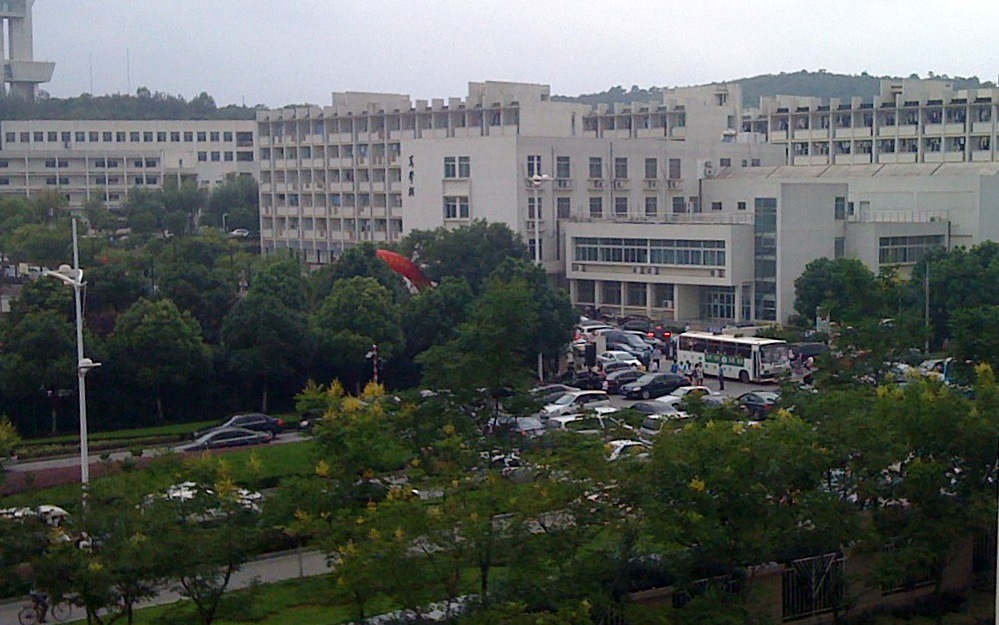
“Start of the semester” traffic next door at Nanjing Normal
University last Saturday. Loud, constant honking all day!

I have also learned to not apply my old logic to how things should work here. For example, I was scared stiff when it came to crossing streets and roads here. You see, even though there are pedestrian crossings and traffic signals for people to cross the street, scooters and motorcycles will ignore the red lights and continue to go through traffic whether it means going straight, turning suddenly down an intersecting street or getting around on a sidewalk- whichever seems to be the quickest approach. As a pedestrian you can cross cautiously, run across as quick as you can in the hope of avoiding any approaching scooters or you can hope that they will swerve around you (do you remember that video game called “Frogger” from the early 80’s? Yea- like that). This angered and frustrated me to no end when we first arrived because it just seemed like a completely lawless, disorderly, self-serving system (or lack thereof). But that was using my old experiences and expectations of how drivers should behave and act in any US city. I now cross the street a little more comfortably if not with more savvy ever since I have thrown away this prior US-logic.

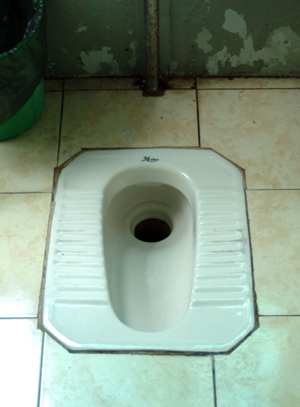
Typical Chinese squat-toilet in public
restroom with bin for soiled tissue.

I also realize that I need to ease in to some activities, functions and rituals. Take the public restrooms. Most standard Chinese bathrooms have squat-toilets which means that the toilets are embedded into the floor with two places for your feet on either side of the bowl. It actually makes a lot of sense to squat while you do your business. In fact I’m sure it’s the most natural way to do it and can be argued to be better for your bladder and other inside parts. Some would say it’s more sanitary as well. Don’t expect to find toilet paper in public restrooms here either. Always be prepared to carry small tissue packets or toilet paper rolls (without the inner cardboard tubes) and never put toilet paper in the toilet! Little waste baskets are provided in the bathrooms for you to put your soiled paper. And isn’t this also better for the septic system? I would say so. Nevertheless, it’s a big adjustment for me to use the public restrooms here (which is why I happily use Western toilets at Starbucks, etc. when they are available). If I can’t get over my fear of using public restrooms and squat toilets, I will get really squeamish when it comes to traveling off the beaten track here in China and using very primitive, rural toilets. Therefore I have resolved to “ease” into using squat toilets here in Nanjing. Today I started using the squat-toilet restrooms here on campus which are pretty clean and sanitary. This may seem like a trivial thing but I am quite proud of this accomplishment and know that I will soon be closer (literally and figuratively) to using toilets in even the most appalling of conditions. Baby steps, baby steps…..

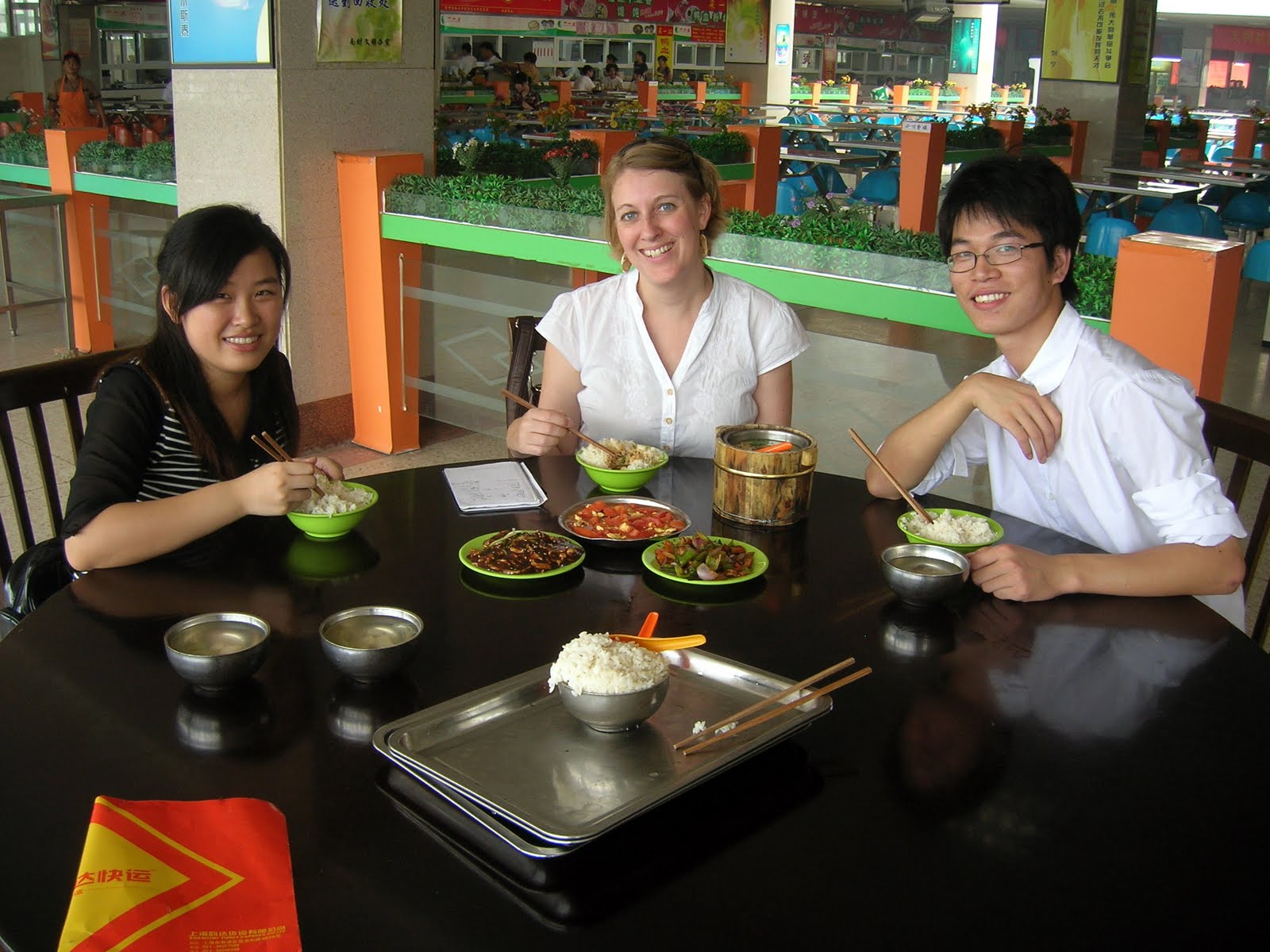
In order to not fall victims to the sense of isolation and homesickness one can experience in being in a new place, Derek and I are slowly putting ourselves out “there” by trying to meet new Chinese friends as well as getting to know the other foreign teachers in our building. This is why I volunteered to help out last Friday at a booth for the English Salon, a social club on campus here at Nanjing University of Finance and Economics where students and foreign teachers can get together to practice English (and Chinese!) conversation and experience such American holidays like Halloween and Christmas (the non-religious side of course). I walked over to the north end of the campus with Randy, one of the new American teachers here at NUFE but certainly a seasoned pro here in China (he’s been here for almost ten years, speaks extensive Chinese and has a Chinese wife). When we arrived we helped the older Chinese students recruit new freshmen to join the club. To be honest I wasn’t very helpful in effectively recruiting new students. Most of the shy, timid freshmen shied away as soon as they saw the big, imposing figure that I am coming towards them and then they completely scampered off as soon as I opened my mouth and said “Hello!!! Would you like to join the English club????” One of the older students politely said, “Hmm, you are quite tall.” And then suggested I might sit down and take a rest. But that is how I met my new friend “Tom” whose English name I helped come up with right there on the spot (so in a way, I have helped “give birth” to someone’s new identity here!). After a while, Tom and Jillian (also obviously not her Chinese given name) whisked Randy and me away and brought us to the cafeteria for lunch. They sought out a corner in the cafeteria that was comfortably situated near the air-conditioner and told us to make ourselves comfortable as they went and selected some dishes for us for lunch. A few minutes later they came back with some tasty dishes such as a tomato scrambled egg dish, some shredded pork with shredded cucumber on top and for me alone- some “zhu tong” which is translated literally to “soup in a bamboo bowl” (**to all my Seattle friends out there- Stan in particular- I had to share this soup reference. Even here they have figured out my love of soup!). Tom and Jill so patiently and graciously helped me with writing down in my little notebook the correct tones and pronunciation as well as pin yin, the romanization system for transcribing Chinese words and names, of all the foods we were eating. It was sitting right there and then with Randy, Tom and Jill that I suddenly realized that Chinese food was again delicious and appetizing for the first time in a week and I had no desire to rush to a McDonald’s for a bacon, double cheeseburger. I was so overwhelmed and touched by their generosity and graciousness and was curious to learn more about their lives. After eating our lunch and the cafeteria almost empty, we strolled our way back to the main part of the campus until we parted ways. Jillian offered to help Derek and me with any Chinese we are interested in learning and Tom also extended the offer for any help we would need.

Enjoying lunch with new friends Jillian and Tom.

Derek and I have had a dream for a couple of years to live overseas. One of my personal reasons for wanting to travel and live overseas was to push our comfort level. I am learning from our experience over the last few days though that pushing your comfort level doesn’t have to be an uncomfortable, icky, painful or stressful experience. Maybe a better way of phrasing it should be finding your own comfort level. Everyone who comes to China eventually finds their own comfort level. Some may be completely content traveling to remote, desolate spots and living for weeks in an abandoned home with no contact with other foreigners or other people for that matter; others’ comfort level can be reached traveling in larger cities with the occasional comforts from home; and then there may be others who enjoy just staying in Nanjing and enjoying all it has to offer as a city and its elements of Chinese life. We have not found our own comfort level here yet. It may be one of the three I just mentioned or perhaps it will be a combination of all three. Exploring and finding our own comfort level here in China is why we’re here.

Originally published: September 14, 2010

TIC- This is China

Standard

A whirlwind few days it has been since our arrival here in Nanjing, China late last Wednesday. We’ve finally gotten settled and are on our on our feet but not without a few minor hiccups. Let me explain..

We arrived late last Wednesday night in Nanjing after 22+ hours of travelling only to find out that our checked-in bags had not arrived. Then, when we finally arrived at our apartment at 1 am Thursday morning in a half daze, we had another little hiccup. What is the first thing you want to do when you arrive at your new home after traveling and sitting for 24+ hours? You of course want to use the bathroom. No sooner had Derek finished his business when he told me the toilet did not flush. The next morning, we discovered the phone in our apartment actually didn’t work as it needed batteries. We bought the AA and AAA batteries but those didn’t fit. Today, when we thought we were finally in the clear of all these hiccups, Derek’s key to our apartment got stuck in our door. An hour and a half later and with the patient work of two men, several tools and W40, we finally have an entire new lock and two new sets of keys. Of course everything works out in the end- the toilet does flush, the key does work, and yes we finally got all of our bags. Normally such events would cause my stress level to spike but I’m learning to not worry about things that are out of my control and to take such small hiccups here with a grain of salt. Why? TIC- this is China. This is what people say around here when something doesn’t work, breaks or there is a little hiccup. It’s just what happens here and all you can really do is relax and trust that things will work out in the end.

So, in addition to experiencing the concept of “TIC”, I have several other first impressions and experiences I would like to share. Keep in mind we are on sensory overload at the moment. Details that may seem rather mundane are both intriguing and amusing to me.

Cute overload
I really can’t get over the obsession here with cute things. If you go onto a dollar store here (which I think are the items that are too cheap to sell at US dollar stores, so you can imagine the abundance of both treasures and crap) and want to buy a lamp, all that is available are little plastic lamps in different pastel colors and with little cartoon sheep and bunnies on them saying “Everyday Goodday! Clouds!!!”. Or if you go into the stationery / bookstore on campus, you can pick from two type of notebooks: Communist party- recycled toilet paper notebooks or pink, polka-dot Hello-Kittyish notebooks. In the Carrefour (it’s a French Wallmart) we bought some household essentials. Waiting in line at the checkout, I eyed a freezer bag that had weird looking cartoon sheep on it that were called something like “Sheep-breeze-bearded Glory!!!”. I thought about it and thought that these Chinese manufacturers must secretly have a way to read my creative five year old nephew’s mind and steal his ideas for nicknames, slogans and expressions. But really the oddest and biggest abuse of cuteness I saw was the other day when a white toy poodle rushed by me in the market with bright orange dyed ears and a tail.

Pictionary and Charades
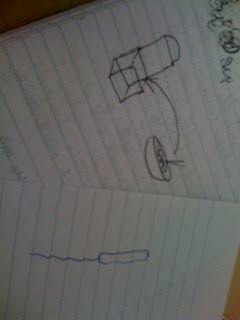
Honing in on my past Pictionary and charade game skills from my childhood, I have been able to communicate on a basic level with people if I am not with a person who speaks Mandarin fluently or on some level. This still leads to some rather embarrassing situations. A few days ago, I went into a nice pharmacy where they sell beauty and personal hygiene products. I was on a mission to find some- ahem- tampons. I looked at what seemed like the Great Wall of Sanitary Napkins. Rows and rows of different brands of pads- and yes- even Hello Kitty ones. Well, I didn’t find my coveted tampons so I finally went up to a couple of woman working in the store and started spouting out names of tampons. “Tampax? Tampons? OB?” They all drew a blank. I then asked is they spoke English (in Chinese- it’s the one sentence I can say) and they summoned a man in the store over. Well, he also really didn’t speak English. Pretty soon there were five of them crowding around me. I searched through my backpack to see if I had a tampon that I show them. Nope. In the end and out of desperation, I had to draw a picture of one. Immediately they stepped back as if they were all embarrassed for me. The man quickly pointed to some boxes of OB tampons- which by the way, were right in front of my face before when I had been scanning for the last five minutes. Honestly, I think they were more embarrassed for me than I was but I felt no shame, because a woman has got to have her comforts. At least now I know where to find them and I’m pleased that my Pictionary skills are up to par.

Dining out
Visiting Derek’s family this summer, his cousin said, “You know what will be the best part of living in China? Chinese food!”. I can happily say Taylor was right and wish we could share some of the wonderful cuisine we’ve tried in the last week. I’m still trying to- literally- get a grip on chopsticks, but we’ve enjoyed some delicious food at street vendors, fancy restaurants and little restaurants under the nearby shopping center. When you arrive at a restaurant here, there is a package of utensils wrapped in plastic wrap at each place which includes a small ceramic plate for food, a small bowl for rice and food, a small teacup for tea, a ceramic spoon, and a small shot glass for drinks. Chop sticks can be found typically in a dispenser on the table or individually wrapped. Napkins are usually not available so it’s best to bring your own packet of tissues (this also comes in handy for public restrooms). Once you sit down, a waitress will immediately come to the table and wait there as the host selects items on the menu. Rather than ordering dishes for each person present, the host selects four or five dishes of meat, chicken, fish and/or vegetables which everyone will share. As the plates arrive you can help yourself to portions of food with your chop sticks and transfer them to your own plate. Rice is viewed as a filler and is something you have to request. The reason for this is if you are a host, you do not want your guests to be hungry. However, if you notice that the dishes ordered are almost empty, you can order rice at the end so that your guests can fill the rest of their appetites with it. Typically I have seen from other tables that people will only eat about half of each of the dishes they ordered and that might be a sign of politeness to show that they are full and have had enough to eat. At some other point I will have to dedicate a separate blog just on food and some yummy dishes we have tried.

Can I help you?
Derek and I have been very lucky to have friends here who have helped us get settled in over the last week. I should add that some students here on campus have also been very helpful and friendly. Over the last couple of days, students have been very helpful making sure my classroom is set up okay, showing me how to use the AV equipment, or how to buy a meal card for the university canteen. I’ve been very impressed so far.

So these are some of my first impressions and experiences. I look forward to sharing more stories, pictures and videos in the weeks to come!

Originally published: August 31, 2010

Trials and Tribulations at the Chinese Consulate

Standard

NOTE: Scroll down towards the end of the posting for advice and info about getting Chinese visas
————————————————————————————————–

One of the most important aspects of preparing to live in China is obtaining a visa. This is something Derek and I had been planning for for several weeks. With our recent road trip down to California in early July to visit family as well as Yosemite and the Redwoods, we planned to add a day or so for sightseeing in San Francisco. On the SF itinerary was this much anticipated trip to the Chinese consulate.

Derek and I tried to make sure that we had all our papers in order. For me this included an official invitation letter from the Chinese government and my future employer, Nanjing University of Economics and Finance that declared that I was fit to work in China. In order to have this invitation letter issued, I had to get an extensive physical exam done which included an echocardiogram, a chest x-ray and blood work testing for HIV and then have the physical exam form officially signed and stamped by my physician so that it could then be sent to China and then the said invitation letter could be issued and mailed back to me. Now for Derek, I insisted he take bank statements showing he had sufficient funds to live in China and wouldn’t be a drain on their system; a copy of international medical insurance; and just to be on the safe side, we drafted up power of attorney forms declaring Derek and I as a responsible couple who will be responsible for one another, in spite of the fact that we are not married and may not be seen as a legal, committed entity in many nations of the world. I was certain that the Chinese consulate people would be very impressed with our thorough preparation and that we would be granted eternal entrance to their magic kingdom. Well okay. At least a 1 year work permit visa for me and a 12-month, multiple entry tourist visa for Derek.

So off we went to the Chinese consulate in San Francisco arriving nice and early- only 15 minutes after the consulate opened. We marched by the quiet protestors giving out pamphlets on human rights abuses in China and the plight of Tibet and got our spot in line outside the embassy. Once in, we grabbed a number to wait for submitting our visa application. Time went surprisingly quickly and I even ran into a former instructor of a class I had taken in Seattle (she was there getting her passport renewed and had gotten up at 6 am to catch a flight down to SF from Seattle!). Finally our number was called and Derek and I marched up to our assigned window where Daisy, our Chinese consulate representative wryly greeted us.

After all the anticipation of this very moment, Daisy didn’t even inquire about our couple status nor did she ask for bank statements or proof of insurance. She simply took Derek’s application and told him that the maximum visa he could be issued was for 60 days (in spite of what is listed on the actual visa form). Then she took my application and wouldn’t you know it, she asked for a copy of my physical exam form which in the rush before leaving Seattle, I actually left in.. Seattle. I also didn’t think it would be necessary for me to have the form since the official Chinese invitation letter I presented her would not have been sent to me without them first getting the medical physical form. Even after I presented the official invitation letters to Daisy, she was still not impressed. I was left to just stick my tail between my legs and walk away.

For the next two days I had to pester many loved ones about the stress I was feeling due to not having a copy of this medical form. First I had to call my friend and housemate Becca in Seattle who would have to dig through my file folders looking for the forms. I also emailed my contact at Nanjing Unviersity begging her to send a scanned copy of the forms. I also am pretty sure I lamented a lot about it to Derek as well as my cousin Steve and his wife Tristanne. She tried to help me by sharing some great stress relief- advise books and I tried to focus on the advice that stress was only self induced and created. In the end, Emy at Nanjing University pulled through and sent me a copy of the medical form as well as the EKG, chest x-ray and blood work results.

When I returned two days to the Chinese consulate, we had much better luck. While I was waiting to meet with Daisy again, Derek was in line to pick up his passport with his visa. As luck would have it, he met a woman in line who was going over to Beijing to visit her son who was working there. She took Derek’s card and next thing you know, Derek got an email from her son and they are indeed interested in his web-design expertise! And as luck would have it for me, Daisy seemed a lot friendlier and my application was processed without any hitches. I was even able to pick it up later that day.

So if you are planning to travel to China, be prepared to shell out a lot of money for your visa. It doesn’t matter if it’s a tourist or work permit visa. All visas to China for American citizens are $140. If you would like to have your application rushed, it’s an extra $20 for 2-3 days and an extra $30 for the same day (a fee I was happy to pay so not to have to return). It’s best to go with an application for a visa in the morning and arrive early enough in the afternoon to pick up a passport before they close (if you arrive 30 minutes before closing, you should be alright). There are consulates in San Francisco, LA, Chicago and of course the embassy in DC. Another option is that you can pay a travel agency or visa service to process and take care of the visa application for you. This seems like the best option if you do not live in a city with a consulate or have the option of traveling to one.

I actually found the Chinese Consulate San Francisco website pretty helpful and you can download the visa application forms from there (as well as the infamous medical form which is only needed if you are trying to get a visa with a working permit to live and work there. This is not required for a tourist visa):

http://www.chinaconsulatesf.org/eng/qianzhen/

Good luck with any future visa endeavors to China and I hope this will not be a deterrent for any prospective visitors of Derek and me in Nanjing!

Originally posted: July 30, 2010